Best Non GamStop Casino UK 2026
Loading...
The Game Changes When the Whistle Blows
Pre-match betting is a forecast. In-play betting is a reaction. The distinction matters because it changes what you’re actually doing when you place a wager. Before kick-off, you’re pricing an outcome based on available information — form, team news, historical data. Once the match starts, you’re pricing an outcome based on what you can see happening in front of you, adjusted in real time by the bookmaker’s algorithms. The information advantage shifts, the odds move continuously, and the decision window shrinks from hours to seconds.
In-play betting now accounts for a substantial share of UK online sports wagering. The infrastructure that supports it — live data feeds, automated odds engines, streaming integration, and cash-out functionality — has matured to the point where live betting is no longer a novelty bolted onto a pre-match product. At the best UK bookmakers, it’s the primary experience. Markets open wider during play than before it, update faster than the broadcast delay, and offer granularity that pre-match odds simply can’t match.
This guide explains how in-play betting works at UK sites, what markets are available, how cash-out functions, and what to consider before placing a live wager.
How In-Play Betting Works
When a match goes live, the bookmaker’s trading system switches from static pre-match prices to a dynamic model that recalculates odds continuously based on the event’s progress. A goal, a red card, a momentum shift, a missed penalty — each triggers an automatic adjustment to every affected market. The odds you see at minute 20 may not exist at minute 21.
The technology behind this is a combination of live data feeds from stadiums (provided by companies like Sportradar and Genius Sports), algorithmic pricing models, and human oversight from in-house trading teams. The data feed captures events — goals, corners, cards, possession changes — and the model recalculates probabilities instantly. Human traders intervene to adjust for situations the algorithm can’t interpret well, such as injuries where the severity isn’t immediately clear or controversial refereeing decisions that might be overturned by VAR.
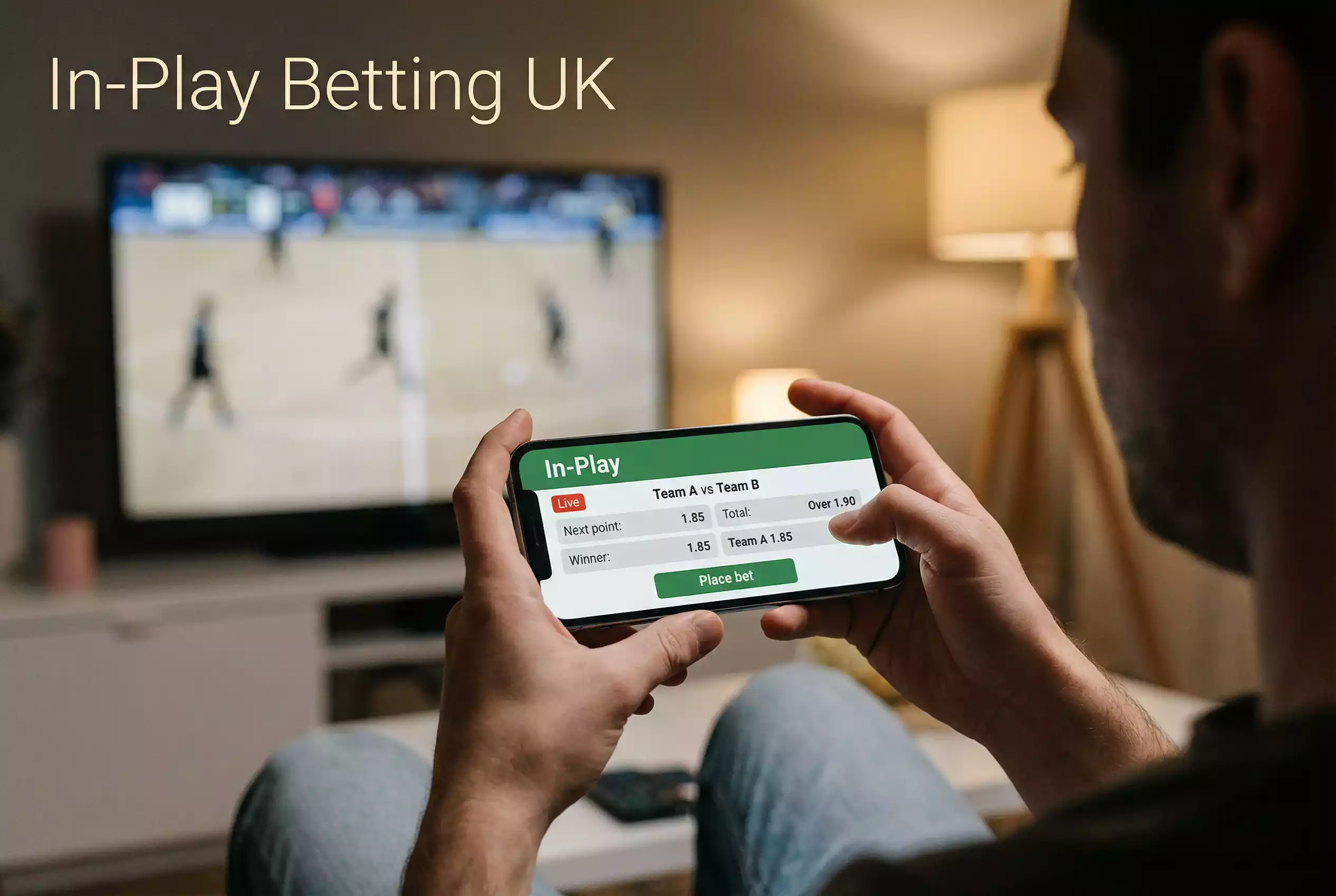
For the bettor, the experience is straightforward. You navigate to the live section of the bookmaker’s site or app, select a match, browse the available markets, and place a bet at the currently displayed odds. The bet is confirmed within seconds if the odds haven’t moved during the placement process. If they have, you’ll receive a notification offering the new odds — a mechanism called “price change confirmation” — and can accept or decline.
The speed of this process varies between bookmakers. bet365 is widely regarded as the fastest in-play platform in the UK, with near-instant bet acceptance and minimal delays between market suspension (during key events) and reopening. Betfair’s exchange offers the unique ability to lay bets in-play — betting against an outcome — which is unavailable at standard bookmakers. Sky Bet and Paddy Power provide reliable in-play experiences with slightly less granular market depth on lower-profile fixtures.
A critical detail: in-play odds incorporate the bookmaker’s assessment of information that may not yet be visible on your stream. Broadcasting carries a delay of several seconds to half a minute, depending on the platform. The bookmaker’s data feed is faster. This means the odds you see have already priced in events you haven’t watched yet. Betting “on what you’ve just seen” in-play is betting on information the market has already absorbed.
In-Play Markets Worth Knowing
The range of markets available in-play is narrower than pre-match but more dynamic. Not every pre-match market translates to live betting — goalscorer markets, for instance, are often suspended in-play because the pricing is too sensitive to real-time positioning.
Match result remains the most liquid in-play market. Odds swing dramatically based on goals and game state. A team trailing 1-0 at half-time might be available at 5/1 to win — a price that reflects both the deficit and the reduced time remaining. If they equalise early in the second half, the odds contract rapidly.
Next goal is a market unique to in-play betting. You’re wagering on which team scores the next goal, or whether no more goals are scored. It resets after each goal, creating multiple betting opportunities within a single match. The odds reflect the current state of play: an attacking team with heavy possession will be shorter to score next than a team defending deep.
Over/under goals adjusts continuously as goals are scored and time elapses. The line shifts during the match — an over 2.5 market before kick-off might become over 1.5 in-play after an early goal, with the odds recalibrated for the remaining time. This market is particularly responsive to match tempo and is one of the best-priced in-play options because the statistical modelling behind goal probability is well-established.
Corners, cards, and time-specific markets open in-play for major fixtures. Next corner, total corners over/under, next card, and time-of-next-goal markets offer high-frequency betting opportunities. The margins on these peripheral markets are wider than on match result or goals, which means the house edge is higher — a trade-off for the granularity and frequency they provide.
Tennis, cricket, and other sports carry their own in-play market structures. Tennis next-game and next-set markets reset with each service game, creating a rhythm of betting opportunities. Cricket offers session runs, next wicket method, and over-by-over markets. The principles are the same: live data drives real-time pricing, and the bettor is wagering on what happens next based on what’s happening now.
Cash Out — Taking Profit or Cutting Losses
Cash out allows you to settle a bet before the event finishes, at a value calculated by the bookmaker based on current odds and the remaining probability of your bet winning. If your bet is winning, the cash-out offer will be positive — less than the full potential payout but more than your original stake. If your bet is losing, the cash-out offer will be less than your stake, reflecting the reduced probability of the bet coming in.
The feature is available at most major UK bookmakers on both pre-match and in-play bets, across singles and accumulators. bet365, Sky Bet, and Paddy Power offer the most responsive cash-out experiences, with offers updating every few seconds during live events.
Partial cash out lets you settle a portion of your bet while leaving the remainder active. If you have a £10 bet at 5/1 and the cash-out offer is £30, you might cash out £20 and leave £10 running. This gives you a guaranteed profit while maintaining exposure to the full payout. The feature requires a minimum remaining stake, which varies by bookmaker.
Auto cash out triggers automatically when the cash-out value reaches a threshold you’ve set. If you want to guarantee at least £50 from a running bet, you set the auto cash-out at £50, and the system executes the moment that value is available. This is useful when you can’t monitor the event continuously and want to protect a profit without manual intervention.
The economics of cash out deserve scrutiny. The cash-out offer includes a margin for the bookmaker — typically 3% to 5% — which means the offered value is less than the mathematically fair value of your position. Over many uses, cashing out systematically reduces your expected returns compared to letting bets run to completion. The feature is best understood as insurance — you pay a premium for certainty — rather than a profit-maximisation tool.
There are moments when cashing out is sensible: protecting a significant accumulator win when the final leg feels uncertain, or cutting a losing position when the match situation has changed fundamentally. There are also moments when it’s counterproductive: cashing out small profits on bets with strong remaining probability, or repeatedly using cash out as a substitute for pre-match stake sizing. The best approach is to treat cash out as an occasional tactical decision, not a default setting.
What to Consider Before Betting In-Play
In-play betting is faster, more frequent, and more emotionally charged than pre-match wagering. Those characteristics make it both more engaging and more dangerous from a bankroll management perspective.
The speed of in-play betting compresses the decision cycle. Pre-match, you might spend thirty minutes researching a wager. In-play, the window between seeing an opportunity and the odds moving past it can be seconds. This compression rewards quick judgment but also punishes impulsive decisions. Having a clear framework before the match starts — what scenarios would make you bet, at what odds, for what stake — provides structure that the in-play environment doesn’t naturally impose.
Stake discipline is harder to maintain during live events. The emotional cycle of watching a match — frustration after a missed chance, excitement after a goal, anxiety during a close finish — creates conditions where increasing stake size feels justified by the intensity of the moment. It rarely is. The bookmaker’s algorithm doesn’t experience emotion. Your odds of winning don’t improve because you care more about the outcome.
Set a session budget for in-play betting and treat it as a hard limit. Track your bets across the session, not just individually. A pattern of five consecutive small in-play bets can add up to a total exposure larger than any single pre-match wager you’d normally place — and the accumulated losses can surprise you at the end of a weekend.
The Odds Move Faster Than Your Instincts
In-play betting gives you more opportunities, more data, and more ways to engage with a live event than any previous generation of gamblers has had access to. That abundance is the feature and the risk. Every market update is an invitation to act, and the bookmaker profits most when you accept too many of those invitations without a clear rationale for each one.
The best in-play bettors are selective. They watch more than they bet. They use the cash-out function sparingly and strategically. And they understand that the odds displayed on their screen are the product of a system that processes information faster than any human can — which means the edge, if there ever is one, is thinner and more fleeting than it appears.