Best Non GamStop Casino UK 2026
Loading...
Two Ways to Gamble, One Set of Rules
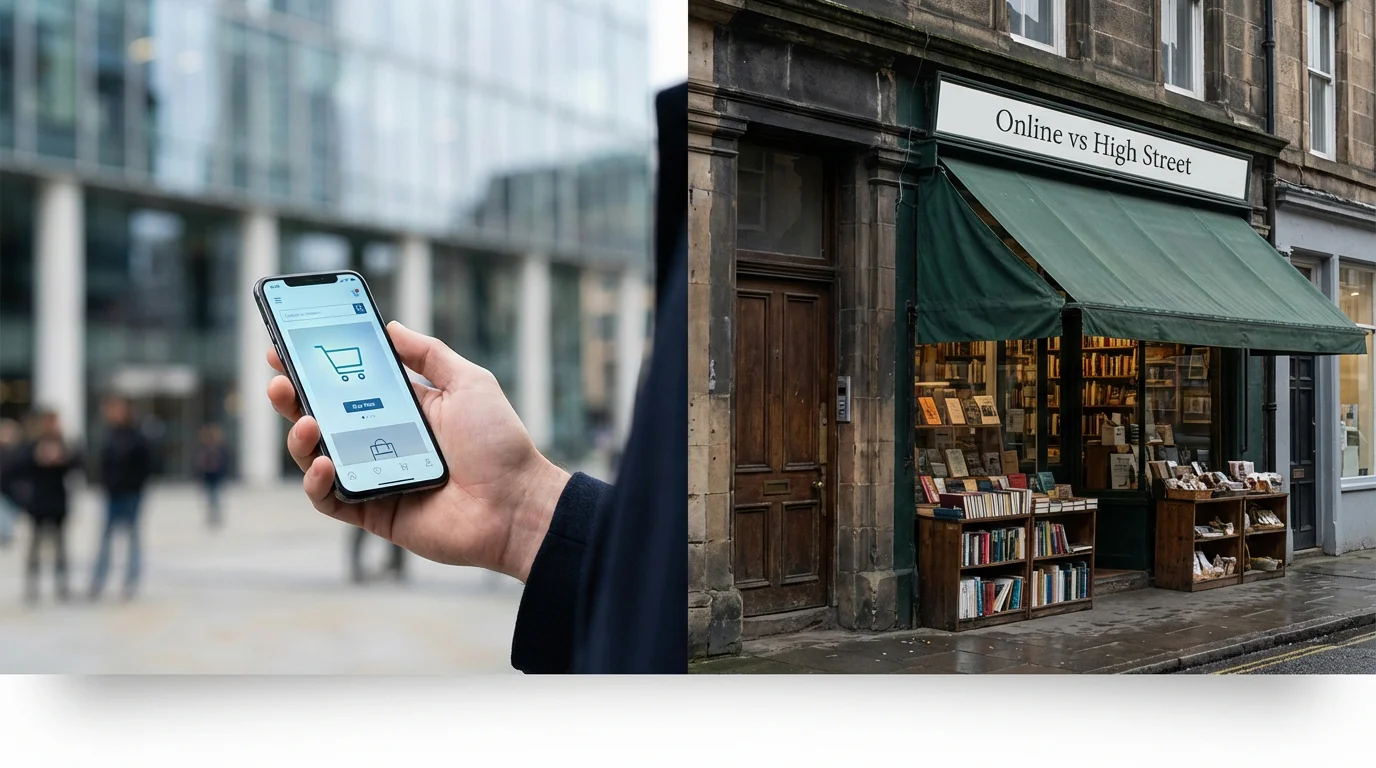
The UK is unusual among gambling markets in sustaining a genuinely active retail betting sector alongside a dominant online industry. High-street bookmakers — Ladbrokes, Coral, William Hill, Betfred, Paddy Power — maintain thousands of shops across the country while simultaneously operating some of the largest online gambling platforms in the world. Both channels are regulated by the UK Gambling Commission, both serve the same underlying activity, and both generate significant revenue. But the experiences they offer are fundamentally different, and the choice between them — or the decision to use both — is worth making consciously rather than by default.
This comparison covers the practical differences between online gambling and high-street betting across the dimensions that matter most: convenience, odds, product range, promotions, atmosphere, and regulation.
Online vs High Street — A Direct Comparison
Product range is the most striking difference. A single online gambling account gives you access to thousands of casino games, hundreds of sports markets per fixture, live dealer tables, poker rooms, bingo, and virtual sports — all available simultaneously and searchable by category, provider, or feature. A high-street betting shop offers a counter for sports wagers, a selection of fixed-odds betting terminals (now limited to £2 maximum stakes), and a handful of virtual racing screens. The online catalogue is orders of magnitude larger.
Availability follows a similar pattern. Online gambling operates twenty-four hours a day, seven days a week. You can place a bet on Australian horse racing at 3am, play live blackjack during a lunch break, or cash out an in-play football bet from a bus. Betting shops operate within regulated opening hours — typically 7am to 10pm — and require physical presence. For spontaneous or time-constrained gambling, online is overwhelmingly more accessible.
Odds competitiveness generally favours online. Bookmakers’ digital platforms can price markets more tightly because the cost of serving an online customer is lower than maintaining a physical premises with staff, rent, and utilities. The difference is most visible on competitive markets like Premier League match results, where online margins might be 3-5% versus 5-8% in shop. Best Odds Guaranteed on horse racing is an online feature — in-shop odds are typically fixed at the price displayed on the board at the time of the bet.
Promotions are overwhelmingly concentrated online. Welcome bonuses, free bets, enhanced odds, acca insurance, and deposit matches are designed for digital acquisition and rarely replicated in shop. The high-street equivalent is typically limited to price boards on selected races and occasional double-result offers. For value-seeking bettors, the promotional gap between online and retail is significant.
Speed of transactions differs by direction. In a betting shop, you hand over cash and receive a slip. The deposit is instant, and if you win, you collect cash over the counter immediately. Online, deposits are instant but withdrawals take hours to days depending on the payment method. The retail model offers unbeatable payout immediacy — a characteristic that matters to players who value instant access to their winnings.
Anonymity and privacy are structurally different. In a betting shop, you can place a cash bet without providing any personal information for stakes under the anti-money-laundering threshold. Online, every account requires full registration, identity verification, and a digital paper trail of every transaction. For players who prefer privacy, the retail environment offers something online cannot — though this anonymity diminishes for larger stakes where AML checks are triggered regardless of channel.
Convenience vs Atmosphere
Online gambling wins on convenience by every measurable standard: access, speed, product range, payment options, and availability. But convenience is not the only dimension that matters.
A betting shop provides something that a mobile screen cannot: physical presence. Watching a race on the shop screen with other punters, hearing the collective reaction to a photo finish, exchanging opinions on form with a stranger at the counter — these are social experiences that have sustained high-street bookmaking for decades despite the commercial logic pointing entirely toward digital migration.
For some bettors, the shop environment imposes a natural discipline that online gambling removes. Walking to a bookmaker takes time. Standing at the counter involves a deliberate act of handing over money. The physical friction of retail betting creates pauses between the impulse to bet and the execution of the wager — pauses that don’t exist when a deposit and bet placement can be completed in three taps on a phone. The absence of friction in online gambling is its greatest convenience and its most significant risk.
The shop also provides a boundary. When you leave, the gambling stops. Online, the gambling is wherever your phone is — which is everywhere, always. The portability of online gambling eliminates the natural session boundaries that physical premises impose. Setting deposit limits and session reminders online is the digital equivalent of deciding to leave the shop and walk home.
Neither environment is inherently safer or more dangerous. Both can be used responsibly or recklessly. The difference is that online gambling requires more deliberate self-regulation because fewer external constraints exist. The shop does some of that work for you through its physical structure. Online, you have to build those structures yourself.
How Odds Differ Between Online and High Street
The pricing gap between online and retail betting is real, consistent, and larger than most casual bettors realise.
Online bookmakers operate with lower marginal costs per customer. There’s no shop rent, no counter staff per transaction, and the technology infrastructure scales efficiently across millions of users. These savings are partially passed to customers through tighter odds margins. On a Premier League match, an online bookmaker might price the market at 103-105% overround (meaning the total implied probability across all outcomes exceeds 100% by 3-5%). The same fixture in a betting shop might carry a 106-110% overround.
The impact compounds over volume. A bettor placing fifty football bets over a season at online odds saves, on average, several percentage points in margin compared to placing the same bets in-shop. That’s the difference between an expected loss of £25 per £500 wagered and an expected loss of £40 — a meaningful gap for anyone who bets regularly.
Horse racing odds in-shop are displayed on boards and updated manually. Online, prices adjust in real time based on market movements. Best Odds Guaranteed — where the bettor receives the higher of the price taken and the starting price — is standard at online bookmakers and effectively nonexistent in retail. For racing bettors specifically, the online odds advantage is substantial.
The exception is cash-out. Betting shop wagers are fixed: once the slip is printed, the bet stands until settlement. Online bets can be cashed out mid-event, which provides flexibility but also introduces the temptation to close bets prematurely. Whether this is an advantage or a disadvantage depends entirely on the bettor’s discipline.
Regulation Across Both Channels
Both online and high-street gambling in the UK are regulated by the Gambling Commission under the Gambling Act 2005. The core protections — licensing requirements, responsible gambling obligations, anti-money-laundering checks, advertising standards — apply to both channels. A UKGC licence covers the operator, not the delivery mechanism.
There are, however, regulatory differences in practice. The maximum stake on fixed-odds betting terminals in shops is £2, a restriction introduced in 2019 to address concerns about high-speed, high-stake gaming in unsupervised retail environments. Online casino games have no equivalent stake cap, though operators must implement affordability checks and spending triggers under UKGC guidance.
KYC verification requirements are stricter online, where full identity verification is mandatory before withdrawals are processed and often before significant deposits are accepted. In-shop, low-value cash transactions can be placed without identification, though staff are trained to identify and report suspicious activity under AML obligations.
Self-exclusion operates differently by channel. GamStop covers all UKGC-licensed online gambling sites but does not apply to physical premises. Self-exclusion from betting shops requires separate registration through the operator’s in-store scheme or through multi-operator schemes like the one administered by the Betting and Gaming Council. A player who self-excludes online through GamStop can still walk into a betting shop, and vice versa. Comprehensive self-exclusion across both channels requires registering with both systems.
Different Doors, Same House
Online gambling and high-street betting are two interfaces to the same underlying activity. The mathematics are identical: the house edge on a roulette spin doesn’t change because you’re watching it on a phone instead of a screen in a shop. What changes is the context — the speed, the access, the social dynamics, the friction, and the promotional environment surrounding each bet.
Online is better for range, value, and convenience. The high street is better for immediacy, atmosphere, and built-in boundaries. Most UK bettors use both, often without thinking about why they choose one over the other in any given moment. Making that choice deliberately — selecting the channel that serves your intentions rather than your impulses — is a small decision that compounds into a meaningfully different gambling experience over time.