

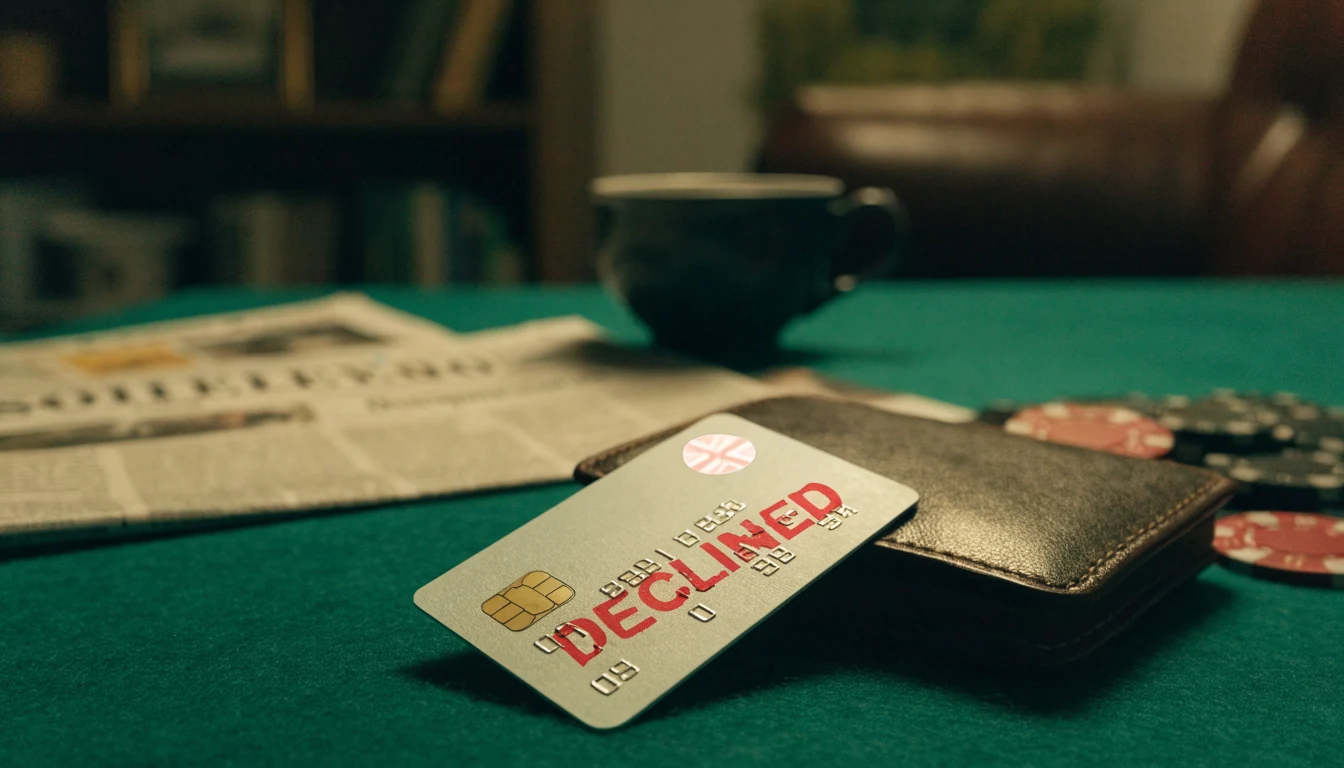
- Why UK-Licensed Casinos Don’t Take Credit Cards
- What to Use Instead of a Credit Card
- Deposits, Withdrawals and the Route Your Money Takes
- Can You Use a Credit Card to Gamble Online in the UK?
- How to Check Whether a Casino’s Payment Claims Apply to You
- When the Credit-Card Gambling Ban Began—and Whether It Changed
- Deposit Minimums and Limits to Check Before Paying
- Are Credit Cards Allowed at UK Online Casinos?
- What Paying by Card Can Cost
- Can You Play Online Slots with a Credit Card?
The key distinction is whether a card draws on bank-held funds or borrows from its issuer, not whether it carries Visa or Mastercard.
Why UK-Licensed Casinos Don’t Take Credit Cards
A UK-licensed casino cannot accept a credit-card payment for gambling. The restriction applies to remote gambling operators serving customers in Great Britain, whether the operator is based in the UK or elsewhere. A site’s payment page may display familiar card brands, but that does not mean a credit card can be used to fund a gambling account.
The distinction is the source of the money, not the logo on the card. A credit card lets you borrow from the card issuer; a debit card draws on money held in your bank account. UK casinos commonly accept debit cards, including Visa and Mastercard, but that does not make credit cards carrying those brands eligible. The same card network can support both kinds of card, while the card product and payment route determine whether a transaction is a debit or credit payment.
That difference can be easy to miss when a casino describes its cashier simply as accepting “Visa” or “Mastercard”. Such wording identifies a payment network, not necessarily every card issued on it. A payment-method list may also be based on general information rather than what is available to a particular customer in the UK. A specialist review, for instance, may list Visa and Mastercard as payment methods without establishing that UK customers can use every type of card bearing those names. The operator’s current cashier is more relevant to a specific transaction.
The prohibition is not a preference that an individual casino can set aside. Remote gambling operators must follow the rules that apply to their UK licence, so a UK-licensed site cannot decide to accept credit-card payments for gambling because a customer requests it or because another payment option is unavailable. A site advertising itself as a UK casino that accepts credit cards should therefore be treated cautiously: the claim may be using “card” loosely, may describe a debit-card option, or may not accurately describe a permitted UK gambling payment.
UK Casino Sites That Accept EcoPayz and Payz
The policy aims to prevent people from funding gambling by borrowing on a credit card. That matters because a credit transaction can make the cost of gambling less immediate: the money is borrowed first and repaid to the card issuer later. A debit transaction uses funds in an account instead. The distinction does not mean a debit payment is automatically affordable or risk-free; it only explains why debit and credit cards are treated differently under the gambling rules.
It also means that a card’s appearance is not enough to establish whether it is usable. A Visa logo, for example, does not tell you whether the underlying product is credit or debit. Nor does a general statement that a casino accepts cards override the restriction. The UK-facing payment information needs to apply to the particular card product and gambling transaction, not just to the brand printed on the card.
There is a further difference between a casino accepting a card for some purpose and accepting it as a gambling deposit. Payment arrangements can be described broadly, but the relevant question is whether the money is being used for gambling. The credit-card restriction concerns credit-card payments for that purpose; it is not a general ban on the existence or use of credit cards. Keeping those ideas separate helps explain why a casino can mention a card brand while still not permitting credit-card gambling payments.
If you are looking for credit card casino sites in the UK, the central issue is not finding a particular operator willing to make an exception. A UK-licensed operator cannot accept a credit card for gambling. Search phrases such as “credit card casino sites UK” can therefore lead to confusing claims: some may mean debit-card casinos, while others may refer to sites outside the UK licensing system. A site’s use of the word “casino” or its acceptance of customers in Britain does not by itself show that it holds the licence required to serve the market legally.
For the same reason, a list of casinos displaying Visa or Mastercard should not be read as a list of UK casinos that accept credit cards. The brand can be accepted for debit transactions while credit-card transactions remain prohibited. The practical dividing line is the funding type, not the payment network’s name. If a payment description does not make that distinction clear, do not assume it covers your card.
UK Credit Card Ban
UK-licensed casinos are prohibited from accepting credit-card payments for gambling. Any site claiming otherwise may not be legally licensed to serve the UK market.
What to Use Instead of a Credit Card
A credit card is not an available route for gambling payments at a UK-licensed casino, but that does not leave you with a single substitute. Debit cards, PayPal, bank payments and some prepaid or e-wallet services work differently, and each operator decides which options to offer. The cashier is where you can see the methods available for your account.
Debit cards
Debit cards are a familiar alternative: UK casinos commonly list Visa and Mastercard debit cards among their payment options. The money comes from the bank account linked to the card rather than from a credit facility. That distinction matters, but it does not mean every card bearing one of those logos will work at every site. A card’s product type and the operator’s available payment arrangements can affect acceptance.
A debit card may suit you if you already use it for everyday payments and want a direct route from your bank account. It is still worth checking the cashier rather than relying on a general list of supported brands. A logo on a page does not confirm that every card product is eligible.
PayPal and other e-wallets
PayPal offers a wallet-based route rather than a direct card payment. A specialist review describes it as valued for speed and convenience, but that is not a guarantee of how quickly a particular casino will process a payment. The operator’s terms also matter: a specialist review notes that PayPal may not qualify for a casino promotion. Read the promotion conditions before depositing if bonus eligibility is important to you.
Skrill and Neteller are other e-wallet names you may encounter. Specialist reviews describe them as available at some casinos and often excluded from promotions, so check the terms attached to the specific offer rather than assuming a deposit method qualifies. An e-wallet is not automatically suitable simply because it is listed: UK rules prevent a casino from accepting wallet payments where credit-card funds can be used for gambling.
Jeton Casino Sites in the UK: Payment Checks
Paysafecard is different from a wallet that supports both directions of payment. It is a prepaid voucher for deposits only, so it is not a complete payment route if you also need the same method to receive withdrawals. Consider that limitation before choosing it.
Open banking and bank transfers
Open banking lets you make a payment through a connection to your bank, while a bank transfer sends money between accounts. They are related ways to pay from a bank account, but the checkout process and availability can differ. A specialist review reports that open banking and bank transfers can support instant deposits and fast withdrawals at many casinos. Treat that as a description of options reported by the review, not a promise that every operator or transaction will work at that speed.
This route may appeal if you prefer paying from your bank account without using a card. Check the instructions shown at the casino, since the available bank-payment option can depend on the operator and its payment arrangements.
Other options
Some UKGC-licensed casinos accept Apple Pay for deposits. Its presence is operator-specific, so it should not be assumed to be available everywhere. Skrill, Neteller and prepaid services also vary by casino; the useful comparison is not simply which names appear on a general payment page, but which methods the particular cashier makes available and what restrictions attach to them.
Debit Cards
Funds are drawn directly from a linked bank account. Common networks include Visa and Mastercard.
E-wallets
Wallet-based routes like PayPal, Skrill, and Neteller. Often offer speed but may be excluded from promotions.
Open Banking
Direct connections to your bank account for transfers. Can support instant deposits and fast withdrawals.
Prepaid Vouchers
Services like Paysafecard used for deposits only. These cannot be used to receive withdrawals.
Before choosing, consider whether the method fits how you want to pay and whether its conditions suit you. A deposit-only voucher, a bank-linked payment and a wallet are not interchangeable. The route that looks simplest at the start may have different terms from another method, including promotion conditions or limits on how it can be used.
Best casino sites in the UK
- BeOnBetBonus: 100% up to €500 + 100 FS · Payout speed: 1-3 business days
- EvoSpinBonus: 125% up to €2500 + 125 Free Spins · Payout speed: 1-3 business days
- SlotoSportBonus: 500% up to £ 10 200+ 777 FS · Payout speed: 1-3 business days
- x3betBonus: Welcome Pack 100% Up to £1.000 + 200 Free Spins · Payout speed: 1-3 business days
- Revery PlayBonus: 100% up to€1,000+ 100 FS · Payout speed: 1-3 business days
- ZombillionBonus: Welcome Pack 250% up to £4000 + 200 FS · Payout speed: 1-3 business days
- DieselwinBonus: Welcome Pack 250% up to £4000 + 200 FS · Payout speed: 1-3 business days
- WinBeastBonus: €5000 + 500 FS + €650 Freebet · Payout speed: 1-3 business days
- BritsinoBonus: Welcome Package – Get your £2,200 + 2,000 FS · Payout speed: 1-3 business days
Deposits, Withdrawals and the Route Your Money Takes
A deposit and a withdrawal are separate stages, even when they involve the same payment account. Money may reach a casino account promptly, but that does not mean a payout will follow the same route or arrive at the same speed. The operator has to approve a withdrawal, apply its checks and send the funds through a permitted payment channel.
For a UK-licensed casino, the normal starting point is the payment source used to deposit. Anti-money laundering rules generally require winnings and returned funds to go back to that original source. This is part of the closed-loop approach: deposits and withdrawals are linked, rather than treated as unrelated transfers. It helps the operator establish where funds came from and where they are going.
The route may be less straightforward if you have used more than one payment method. An operator may return some funds to the original source and ask you to provide another account for the balance, subject to its rules and checks. A payment method that accepts deposits is not necessarily available for withdrawals, so check the casino’s withdrawal terms before paying in. If a route cannot receive a payout, the casino may need to arrange an alternative and verify that it belongs to you.
Using an account and payment route in your own name can reduce avoidable friction over ownership. Details that do not match may lead to questions or additional checks before a withdrawal is approved. This does not remove the operator’s right to carry out KYC—identity and account checks—or other required reviews. It does make it easier to show that the deposit and payout are connected to the same customer.
A first withdrawal can take longer than later ones if the account has not yet been fully verified. The casino may ask for documents or information before releasing funds, and it has its own internal approval process. A specialist review of casino withdrawals notes that both approval and verification can affect processing time; the payment provider then has its own part in delivering the money. A displayed processing estimate is therefore not necessarily the time from clicking “withdraw” to seeing funds in your account.
The method can also affect the final leg of the journey. PayPal, open banking services and debit cards connected to fast payout systems are described in specialist payment reviews as among the quicker withdrawal routes. That is not a promise about an individual transaction: the casino’s review, account status and payment provider still matter. Bank transfers may also be affected by cut-off times, weekends or currency conversion, so the time shown by an operator may not cover every step.
If a payout is pending, check whether the casino is still reviewing it or whether it has already been sent. Those are different stages, and contacting the payment provider is unlikely to resolve a withdrawal that the casino has not yet approved. The cashier or withdrawal history may show the status; if it does not, ask the operator which step remains outstanding.
Casinos That Accept Citadel in the UK: How to Check
Credit-card funds are not a valid way to make gambling deposits at a UK-licensed casino, including when routed through a money service business or a wallet that permits credit-card funding for gambling. That restriction does not alter the general return-to-source principle: it means a prohibited funding route should not be used in the first place.
Before confirming a deposit, consider the likely withdrawal route as well as the initial payment. Check whether the same account can receive payouts, whether the casino may request verification, and what its stated processing stages mean. A payment can be quick in one direction and slower in the other; the route, approval and account checks all shape when money becomes available.
Can You Use a Credit Card to Gamble Online in the UK?
No. A remote gambling licensee serving customers in Great Britain cannot accept credit-card payments for gambling. That applies whether you are opening an account, adding funds to an existing balance or trying to pay through an intermediary. A payment route does not become eligible simply because the card is not presented directly to the casino.
The key distinction is the source of the money. If you use a credit card to fund a money service business and then send the resulting payment to a gambling account, the operator cannot accept it as a workaround. The same restriction applies when credit-card funds are routed through a wallet that allows those funds to be used for gambling. Changing the name or appearance of the payment method does not remove the credit-card funding behind it.
This matters when a payment service offers several ways to add money. A wallet may be usable for some transactions but not for gambling funded by a credit card. The relevant question is not only whether the casino displays the wallet’s name in its cashier; it is whether the funds being used have come from a prohibited credit-card payment route. Do not assume that a wallet can be used to pass a credit-card deposit through to a casino.
A credit card is also different from a debit card, even if both carry a familiar card-network name. A debit card draws on money in an account, whereas a credit card provides access to borrowed funds. UK casinos commonly accept debit cards, including Visa and Mastercard, but that does not mean the corresponding credit-card products can be used. The product type, rather than just the logo on the card, matters.
If you are unsure which type of card you have, check the card or account details with your provider before trying to pay. Do not treat a successful payment at a shop or another online service as evidence that the same card can fund gambling. Gambling transactions are subject to a specific restriction, and a payment that works elsewhere may not be accepted for this purpose.
The restriction applies to online casino deposits, not just to a particular game or type of account. Whether you intend to play table games or online slots, you cannot use a credit card—or a prohibited credit-card-funded intermediary route—to put gambling funds into a UK-licensed casino account. If a payment option appears in a cashier, that display should not be read as permission to use credit-card funds through it.
Do
- Use a debit card in your own name
- Check the cashier for available methods
- Keep ownership details consistent
Don’t
- Use a credit card for deposits
- Route credit funds through a wallet
- Try variations of prohibited routes
Keep the ownership details consistent when making a permitted payment. Using an account and payment route belonging to you helps avoid basic mismatches over who is sending the money. It does not make a credit-card route acceptable, but it can reduce avoidable friction around a transaction made with an eligible method.
If a transaction fails, do not keep trying variations of the same credit-card route. A money service business or wallet is not a way around the restriction. Use a payment method that is not funded by a credit card, and make sure it belongs to you. The central practical point is straightforward: for gambling at a UK-licensed casino, credit-card funding remains out of bounds whether it reaches the operator directly or through an intermediary.
How to Check Whether a Casino’s Payment Claims Apply to You
A payment logo or list on a casino’s website is a starting point, not confirmation that the method will work for your account. A specialist review may describe a site as accepting Visa or Mastercard, but that does not establish which card products are currently supported for customers in the UK. The cashier is the place to check the options presented to you.
The network name alone does not tell you whether a particular card is eligible. Visa and Mastercard both cover different card products, and a site’s general payment information may not distinguish between them. Check the cashier’s wording and any terms linked from it. If the information does not say whether your card type is supported, ask the operator before attempting a transaction.
This distinction matters when a page appears to promise credit-card deposits. A card logo does not mean that credit-card payments for gambling are permitted. UK-licensed casinos cannot accept them, and a payment route that disguises credit-card funds does not make the transaction eligible. Look for clear information about the accepted card type rather than treating a network logo as an answer.
The cashier can also show whether a method is available to you at that moment. Payment options may depend on where you are, the account you are using, or the product attached to your card. A method described elsewhere on the site may not appear once you sign in. Before relying on a claim, open the deposit page in your own account and check the available choices and any conditions shown there.
If you are unsure, contact customer support with a specific question: name the payment network and say whether your card is debit or credit. Avoid sending full card details in a message. The operator should be able to explain what its cashier supports without asking you to disclose sensitive information.
A payment method appearing in the deposit cashier does not, by itself, tell you whether it can also be used for withdrawals. Check the withdrawal information separately before choosing a route. The same care applies to e-wallets and other services: confirm the exact option available to your account rather than relying on a general list.
Checking Payment Claims
Sign in to your account
Open the deposit page while logged in to see the options actually available to you.
Inspect the cashier
Check the specific wording and terms linked to the payment methods listed.
Verify with support
Ask customer support specifically if your card product (debit or credit) is supported by the network.
Be cautious with pages that group UK casinos together without explaining how their payment claims were checked. A specialist review can be useful for identifying methods to investigate, but availability can change and a general list cannot confirm your personal eligibility. In particular, a mention of Visa or Mastercard should not be read as confirmation that every card on that network works.
The practical check is straightforward: sign in, inspect the cashier, read the conditions attached to the method, and ask the operator if the card product remains unclear. That separates a broad marketing claim from the payment choices actually offered to you.
When the Credit-Card Gambling Ban Began—and Whether It Changed
The UK credit-card gambling ban took effect on 14 April 2020. From that date, remote gambling operators could no longer accept credit-card payments for gambling. The restriction covers gambling at UK-licensed online casinos; it is not a temporary policy or a rule that has since been relaxed.
The date matters because it separates the current position from any older information you may encounter. A page, payment guide or account of casino rules written before the ban took effect may describe arrangements that no longer apply. Even if a page has been updated, check that its statement about credit cards reflects the rule now in force rather than an earlier description.
There has been no later easing of the ban. In other words, the answer to whether credit cards are allowed for gambling in the UK has not changed since the restriction began: a UK-licensed remote gambling operator cannot accept them for that purpose. A casino’s own payment information cannot override that requirement.
The ban is specific to credit-card payments for gambling. It should not be read as a general ban on every card payment or as evidence that the rule has expired. Debit cards are a separate payment type, and their acceptance is not what the 2020 restriction removed. That distinction matters when reading older material that uses “card” loosely, without saying whether it means credit or debit.
Nor should the date be mistaken for a rule that applied only when it first came into force. The restriction remains in effect, so a casino cannot treat the earlier date as a historical detail with no bearing on present payments. If a claim suggests that a UK-licensed casino now accepts credit cards for gambling, it conflicts with the continuing ban.
The question of why credit cards were banned is separate from the timeline. The date and continuing status establish what the rule requires; they do not, on their own, explain the policy reasoning behind it. It is more useful to keep those points distinct than to attach a motive to the ban without support. For a reader trying to understand the rule’s history, the reliable point is straightforward: the restriction began on 14 April 2020 and has not been relaxed.
That fixed timeline also helps put current descriptions in context. A statement that a casino accepted credit-card gambling payments before the effective date would not show that the same payment is permitted now. Likewise, a claim that the restriction was later lifted would not match its continuing status. The rule is not a matter of a particular operator’s preference: it is the regulatory position that applies to remote gambling operators serving the UK market.
Casino Payments in the UK: Methods and Deposits
So, when considering the UK casino credit-card ban, keep two facts in view: it took effect on 14 April 2020, and it remains in force. Those points answer both when the restriction began and whether it has changed.
Deposit Minimums and Limits to Check Before Paying
A minimum deposit is the smallest amount a cashier will accept for a particular payment method. One specialist casino review places starting minimums in the £10–£20 range, with the amount depending on the method selected. Treat that as a guide from one review, not a standard applying to every UK casino: the figure shown in the cashier is the one that matters for your account.
Minimums and maximums are separate conditions. A method may accept a small initial payment but impose a ceiling on each transaction. The operator may also set daily or monthly deposit caps, and the maximum available can vary with the payment method and your account status. Check each limit before confirming a payment, especially if you are planning more than one deposit. A limit displayed for one method should not be assumed to apply to another.
Read the wording carefully. A transaction limit concerns a single payment; daily and monthly limits apply across the relevant period. If the cashier shows a maximum but does not make clear whether it applies per payment or across a period, consult the operator’s payment information or ask customer support before proceeding. Do not assume that splitting a payment changes a daily or monthly cap.
Casinos That Accept eChecks in the UK: What to Check
There is also a distinction between the casino’s payment limits and your own gambling controls. UK Gambling Commission rules require remote gambling licensees to prompt new customers to set a financial limit before their first deposit, and to make account-level limit controls accessible. Set a limit you can afford and understand what it covers before paying; it is not the same as the maximum deposit the cashier will permit.
Check the amount and the relevant period in the cashier, then review your account controls before making a deposit. Limits can differ by payment route and account status, so an amount available to another customer—or shown in a general guide—may not be available to you. If the displayed terms are unclear, pause and get confirmation from the operator rather than relying on an assumption.
Are Credit Cards Allowed at UK Online Casinos?
No. UK-licensed online casinos cannot accept credit-card payments for gambling. If you are looking for a credit card casino in the UK, you will not find a lawful UK-licensed operator that can take a credit-card deposit for play.
A credit card and a debit card may carry the same familiar network logo, but they are not interchangeable for this purpose. A credit card lets you borrow from the card issuer; a debit card takes money from funds held in your bank account. UK casinos commonly accept debit cards, including Visa and Mastercard, but that does not mean every casino accepts every card product.
The distinction matters when you choose a card in a cashier. A Visa or Mastercard logo alone does not tell you whether the card is credit or debit, nor does it establish that a particular card will work. Check the card type and the payment options the operator makes available to you. Do not assume that a credit card becomes eligible simply because it is linked to a familiar payment service.
Card Distinction A Visa or Mastercard logo identifies the payment network, not the card product. Only debit versions of these cards are permitted for gambling deposits at UK-licensed casinos.
If a payment is declined, do not keep trying to route credit through another product for gambling. The restriction is about the source of the funds, not just the label shown on a card or payment screen. For a permitted card payment, use a debit card in your own name and follow the operator’s instructions.
So the direct answer is that credit cards are not allowed for gambling deposits at UK online casinos, while debit cards may be accepted. That distinction is the essential one: the card network name does not determine whether a payment is permitted.
What Paying by Card Can Cost
A card payment can carry more than one possible cost. A specialist payment-method review identifies charges from the casino, the payment provider, the card issuer or bank, currency conversion and the card network as potential sources. Which of these applies depends on the transaction and the terms of the organisations involved; a fee shown by the casino is not necessarily the full cost.
A fixed charge is easy to spot, but it is only one part of the calculation. If your account or transaction uses a different currency from your bank account, conversion may involve an exchange-rate spread: the rate applied can be less favourable than a reference rate. A specialist review notes that this difference can cost more than a visible flat fee. The amount may not appear as a separate line labelled “fee”, so compare the amount debited from your account with the value credited to the casino balance.
Other charges may be set by the card issuer, bank, provider or network rather than the casino. Check the payment screen and the relevant account terms, including how currency conversion is handled and whether a third party adds a charge. Do not assume that a casino’s statement of “no fee” covers costs imposed elsewhere in the payment chain.
Casinos That Accept Upaycard in the UK: What to Check
There is no single card route that is cheapest in every case. To compare options, use the same intended deposit amount and currency, then account for any casino charge, provider or bank fee, conversion spread and network cost that applies. A route with no visible fixed fee can still cost more overall if its exchange rate is less favourable. Confirm the account currency before paying, and check the final amount shown by your bank or provider after the transaction.
Can You Play Online Slots with a Credit Card?
No. At a UK-licensed casino, you cannot use a credit card to fund an online slot session. The restriction applies to gambling deposits generally, not just sports betting or particular casino games. Choosing a slot rather than another game does not make a credit-card payment acceptable.
A debit card is different: it draws on money in your bank account rather than borrowing on a credit facility. UK casinos commonly accept Visa and Mastercard debit cards, but that does not mean every card bearing those names will work at every cashier. Check that the card is a debit card and that the casino lists it as available to you.
The distinction matters when you select a payment method. A card may look familiar and carry a recognised network logo, yet its product type determines whether it is a credit or debit card. If you are unsure, check with your bank before attempting a deposit. Do not treat a failed credit-card transaction as a prompt to find another route for using borrowed funds.
There are separate rules for how online slots operate in Britain. Autoplay is prohibited, so you must start each spin yourself rather than set a sequence to run automatically. A spin must also last at least 2.5 seconds. These requirements apply to the game itself; they do not change which payment methods a casino may accept.
Online gambling is legal for adults aged 18 and over at sites licensed by the UK Gambling Commission. Before depositing, make sure you are using a licensed operator and understand the payment method shown in its cashier. If you want to play slots, a permitted debit-card deposit may be an option; a credit-card deposit is not.
Can I use a credit card at 333 Casino in Great Britain?
No, a UK-licensed casino cannot accept credit-card payments for gambling. Check that any card you use is a debit card and that it is eligible in the casino’s cashier.
Why must withdrawals return to the deposit method?
Returning funds to the original payment source is a common anti-fraud and anti-money-laundering measure. Using the same account for deposits and withdrawals can also reduce avoidable payment delays.
What is the fastest withdrawal method for UK casinos?
PayPal, open banking and debit cards linked to fast payout systems are generally among the quickest options. The casino’s approval process and your verification status also affect how soon you receive the money.
Do UK casino withdrawals require verification?
Casinos may need to verify your account, and first withdrawals can take longer while checks are completed. Having a fully verified account can help avoid delays.
Why can a fast payout casino still delay my withdrawal?
A fast payment method does not bypass the casino’s internal approval process. Verification, especially for a first withdrawal, can add time; bank transfers may also be affected by cut-off times and weekends.
What is the current minimum deposit?
The minimum deposit usually starts at £10–£20, depending on the payment method you choose.